

Business and Human Rights: Ukraine’s Implementation of the United Nations Guidelines (26.09.2018)
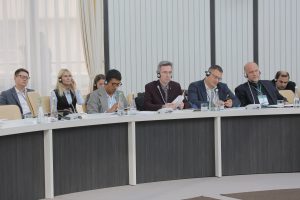
A panel discussion “Business and Human Rights: Ukraine’s Implementation of the United Nations Guidelines” was held on September 26 within the framework of the II Kharkiv International Legal Forum. Over 130 participants, representatives from 10 countries of the world met at a round table in the conference hall of Yaroslav Mudryi National Law University Learning and Library Complex to discuss the prospects for the implementation of recognized standards in the field of business and human rights in Ukraine.
The main purpose of the panel discussion was to initiate in Ukraine the process of developing, adopting and implementing of the National Action Plan in the field of business and human rights. Successful realization of this goal became possible due to the fact that all key participants of this process responded to the invitation of the organizers of the Forum and took part in the panel discussion – the officials, the National Contact Point, the Secretariat of the Ombudsman on Human Rights of the Verkhovna Rada of Ukraine, the Government Commissioner for Gender Equality, representatives of local self-government, the Council of the Business Ombudsman, the Federation of Trade Unions of Ukraine, public organizations, business representatives and the academic community.
An important part of the successful further work on the National Action Plan in the field of business and human rights was the participation in the panel discussion of international experts and foreign guests who told about the experience of those countries that already have National Action Plans. What positive and negative lessons should Ukraine take into account? What models of the NAP development can be used? What subjects should be involved in the discussion of the NAP? These and other issues became the subject of attention of participants of the panel discussion.
All participants received first translated into Ukrainian: United Nations Guidelines in the Field of Business and Human Rights; Methodical Manual on the Development of the National Action Plan for Business and Human Rights; The Guiding Principles in the Field of Business and Human Rights for Bar Associations approved by the IBA.
The panel discussion was opened with the greetings of the Vice-Rector on Academic Work of the Yaroslav Mudryi National Law University Yurii Barabash and the panel coordinator Olena Uvarova, who welcomed the guests of the panel discussion, thanked for their sincere interest in the II Kharkiv International Legal Forum, wished a fruitful discussion and expressed their hopes for the practical realization of provisions and ideas accumulated during the panel discussion.





Internationally recognized experts in the field of business and human rights – Dirk Hoffman (Danish Institute of Human Rights) and Beata Farachik (Polish Institute of Human Rights and Business) made welcoming remarks. According to their words, the experience of other countries proves that the most successful initiatives for the development of the National Action Plans for Business and Human Rights began precisely from broad discussions such as the panel discussion. In turn, the University as a reputable academic institution with the autonomous status and equally distant from both the state and business is the optimum platform for such discussions at the national level.
Anita Ramasastri, member of the United Nations Working Group on Business and Human Rights, Professor of Law, Director of Postgraduate Programs at the Department of Stable International Development of the Law School of the University of Washington, USA, and Michael A. Santoro, Professor at Santa Clara University of Leavey School of Business, co-founder and co-editor of the magazine “Business and Human Rights” (Cambridge University Press), President of the Global Association of Business and Human Rights addressed their panelists through video message.
The work of the panel discussion began with an introductory presentation by Tanel Kerikmäe, Director of the Tallinn School of Law, Faculty of Business and Management, Tallinn University of Technology (Estonia). Prof. Kerikmäe devoted the report “GDPR: Implementing of Recognized Human Rights Standards by Business” to one of the most relevant innovations at the EU level in business and human rights – regulation that protects privacy and personal data.
The first session “Business and Human Rights in Ukraine: Implementation of International Standards” under the moderation of Olena Uvarova began with the presentation of the Director-General of the Directorate for Human Rights, Access to Justice and Legal Awareness of the Ministry of Justice of Ukraine Vladyslav Vlasiuk. Mr. Vlasiuk presented an analysis of the current situation in Ukraine regarding the implementation of its obligations by business in the field of human rights. He reported on the activities of the Directorate, which he leads, and outlined the prospects for the development of this issue in the near future. The Ministry of Justice of Ukraine is ready to act as the coordinator of the work on the elaboration of the National Action Plan for Business and Human Rights. The first step in this direction should be the preparation of a comprehensive study of positive and negative aspects of the impact of business on human rights, as well as the legislation of Ukraine on its compliance with the standards of business and human rights. Among the expected results is the optimization of business legislation in the context of deregulation and bringing it into line with the best practices in the field of human rights, bringing business practices that are applied by Ukrainian enterprises in line with international standards, creating a positive business image as one that respects human rights.
Hryhoriy Osovyi, Head of the Federation of Trade Unions of Ukraine, spoke about the important role of trade unions in ensuring of human rights. He spoke about the main stages of formation of trade unions in Ukraine and made a comparative analysis of the activities of trade unions of Great Britain and Ukraine in the field of human rights protection. Mr. Osovyi expressed the readiness of the Federation of Trade Unions of Ukraine to be actively engaged in the elaboration of the National Plan of Business and Human Rights.
Maryna Kupchuk, Deputy Head of the Investment Policy Development Unit of the Investment Attraction Department of the Ministry of Economic Development and Trade of Ukraine, representative of the National Contact Point of Ukraine shared important information on the work of the National Contact Point as an institution significant for the implementation of international standards of business and human rights with those present. In Ukraine, this institution is only beginning its work and is ready to be actively engaged in relevant initiatives in this area.
Proceeding with the thought about the role of the National Contact Point, Maryna Saprykina, Head of the Center for Corporate Social Responsibility Development, revealed the key requirements of the Guiding Principles of the Organization for Economic Development and Cooperation in the implementation of relevant standards and positive business practices. Accordingly, the human rights policy should be approved by companies at the level of the highest governing bodies. The key is that such a policy has:
- to be confirmed by the domestic or foreign expertise.
- provide expectations for the company’s staff, its business partners and interested parties.
- to be openly accessible.
- The company’s staff, partners and interested parties must be aware of the corporate human rights policy.
- The human rights policy finds appropriate application in the operating policy and procedures of the company.


Yaroslav Gregirchak, the Deputy of the Business Ombudsman, in his speech “New Tools for Establishing Effective Dialogue between Business, State and Society: the Experience of the Business Ombudsman’s Council” described the unique experience of functioning in Ukraine the Business Ombudsman’s Council, which represents and protects business interests in the state organs. The new institution is called to ensure transparent running of business in Ukraine. One of the key objectives of the Business Ombudsman’s Council is to ensure effective systemic communication of business with the authorities, state organs and local self-government, as well as enterprises that are state-owned or subordinated to the state organs.
Kateryna Levchenko, Governmental Commissioner for the Gender Policy, drew attention to the importance of incorporating the gender component into the National Action Plan on Business and Human Rights. Ms. Levchenko outlined the main issues that should be taken into account in the work over the Action Plan in order to create a proper mechanism for ensuring gender equality by business.
Larysa Shvetsova, member of the High Council of Justice, judge of the Court of Appeal of the Kharkiv region, turned to the issue of effective legal remedies, in particular, judicial, in case of violation of human rights by the business. This is one of the key elements of the United Nations Guiding Principles on Business and Human Rights, and this aspect should be properly reflected in the National Action Plan. The Justice sector is ready to join the relevant developments and working outs.
Svitlana Romanova, Director of Legal Assistance to the Metinvest Group, presented the report “Application of the UN Guidelines for Business and Human Rights on the example of the Ukrainian company”. She emphasized that each socially responsible company establishes its own priority directions for the protection of human rights, taking into account: its corporate principles and values; business orientation; strategic development plans. Businesses more often give preferences for the ensuring: labor safety; product safety; non-discrimination; non-employment of children. The practice of joining companies to the UN Global Contract is positive. By this they voluntarily agree to include the basic principles of human rights protection in their development strategy and practice. Each year such companies report on the results of observance of the basic principles of human rights protection.
The second session “The National Action Plan on Business and Human Rights: Lessons Learnt and Risks,” aimed to familiarize the participants with developed by the international organizations models and practices for the development of National Action Plans in the field of business and human rights, and to discuss the experience of those countries that already have such plans and switched to their implementation. Ella Skibenko, the Resource Center for Business and Human Rights representative and researcher of Eastern Europe and Central Asia was the moderator of this part of the discussion.
Dirk Hoffmann, Danish Institute for Human Rights (Denmark) and Beata Farachik, the President of the Polish Institute for Human Rights and Business (Poland), are the recognized international experts on business and human rights. The experts noted that the adoption of the United Nations Guidelines on Business and Human Rights by the UN Council on Human Rights in June 2011 has become a significant step in the development of normative standards of business corporate responsibility and accountability. Three years later, UN Member States were urged to develop national business and human rights Action Plans to support the implementation of the Guidelines. The United Nations working group on Business and Human Rights, established in 2011, strongly recommends all countries to develop, approve and continuously update the NAPs in the field of business and human rights. The leaders of the G-20 also express their support for approving such plans.
Approved in September 2015, the Sustainable Development Agenda by 2030 recognizes the role of business as the key driving force of economic growth and infrastructure development as a prerequisite for achieving sustainable development goals, and urges the business to act in accordance with the Guidelines.




Currently 21 countries of the world have adopted such Action Plans (including Denmark, Poland, Czech Republic, Lithuania, the USA), and 23 more are in the process of such development. The European Union has been actively involved in the implementation of the UN Guidelines on Business and Human Rights. Among the objectives of the EU Action Plan on Human Rights and Democracy for 2015-2019 is raising awareness of the countries that are not the members of the EU with the United Nations Guidelines on Business and Human Rights. Of particular interest to Ukraine as a member of the Council of Europe are the Recommendations CM / Rec (2016) 3 of the Committee of Ministers of the Council of Europe. In accordance with these Recommendations, the Member States should: review the national laws and practices regarding their compliance with business and human rights standards; to raise awareness of the state bodies and other institutions on corporate social responsibility issues, the recommendations of the Council of Europe on business and human rights, etc.; to disseminate good practices in the field of business and human rights; to prepare and disseminate the National Action Plan on the Implementation of the United Nations Guidelines on Business and Human Rights, as well as to disseminate best national practices in this sphere; to carry out an examination of the implementation of the Recommendations not later than 5 years after their adoption (i.e. until 2021).
International experts noted that the preparation of the National Action Plan stipulates:
- Conducting of the national assessment of the basic indicators of compliance by the state and the enterprises obliged to with the UN Guidelines;
- Planning the implementation of the NAP, guided by the principles of inclusiveness and public participation;
- Carrying out an objective analysis to determine the priorities of the NAPs in the field of business and human rights and the actions that should be foreseen by them;
- Identification of the effective follow-up actions on monitoring, reporting and evaluation of the implementation of the NAPs in the field of business and human rights;
- Improvement of the quality of monitoring and reporting on NAPs at the national, regional and international levels;
- Evaluation of the progress in the implementation of the Guiding Principles.
The challenge for states that develop NAPs in business and human rights is to find the answer to the question of how such plans can be implemented or brought into line with planned documents in other areas, especially those with which they can intersect.
Lyra Jakulevičienė, Dean of the Faculty of Law, Head of the Human Rights Laboratory of the Mykolas Romeris University, a co-founder of Lithuanian Business Responsibility Network, and Toma Birmontienė, Professor, Chairman of the Lithuanian Center of Human Rights (1995 – 2004), Judge of the Constitutional Court of Lithuania (2005-2014), Chairman of the Baltic-Ukrainian Center for Research and Innovation shared interesting experience in developing and implementing their country’s National action plan for Business activities and in the sphere of the protection of human rights. Lithuania is currently on the second stage of implementing its own National action plan, which allows Ukraine to take into account both the positive aspects of the implementation of the plan and the difficulties that had to be faced.
The National action plan is essential for defining the main directions of the business’s impact on human rights, since human rights are often violated in those social relations which are noted in the National action plan. The strategic goal of such a plan is that every representative either of small, medium or large business should know what new trends in the field of production safety, gender sensitivity, social corporate responsibility should be taken into account in order to preserve human rights as well as to compete successfully in the modern market.
Itka Brodska, diplomat, Deputy Director of the Human Rights and Transitional Policy of the Ministry of Foreign Affairs of the Czech Republic, who is a direct participant in the process of development and implementation of the NAP in the Czech Republic, and Alla Timofeieva, Law Faculty of the Charles University (Czech Republic), a member of the ESIL Interest Group on International Business and Human Rights reported on the experience of the Czech Republic. Particular attention was paid to such components of the Czech Republic’s NAP as criminal liability of legal entities for human rights violations ensuring proper accuracy mechanisms (Due diligence), and access to justice.
The comparison between the European and American approach to the development and implementation of the National Action Plans for Business and Human Rights was made by Taylor Boren, a lawyer in the lawsuits of the Tamaki Law Office (USA), a graduate of the Fulbright Program on Legal Regulation of the Protection of Persons with Disabilities in the EU and in the United States.


The moderator of the third session “On the Way to the National Action Plan for Business and Human Rights in Ukraine” was Mariia Yasenovska, President of the Kharkiv Regional Foundation “Public Alternative”. The session was aimed at developing a roadmap for Ukraine on the development of the National Action Plan in the field of business and human rights. For this panel discussion participants were divided into groups:
Group I – Legislative power and Ombudsman Office of the Verkhovna Rada of Ukraine (Moderator: Olena Stepanenko, Representative of the Human Rights Commissioner of the Verkhovna Rada of Ukraine in Social and Economic Rights Protection; Assistant: Kateryna Buriakovska, Yaroslav Mudryi National Law University)
Group II – Executive and local self-government bodies (Moderator: Vladyslav Vlasiuk, General Director of the Directorate of Human Rights, Access to Justice and Legal Issues of the Ministry of Justice of Ukraine; Assistant: Nataliya Gerasymchuk, Directorate ??????
Group III – Ensuring Equal Rights and Opportunities for Women and Men (Moderator: Kateryna Levchenko, Government Commissioner for Gender Equality; Assistant: Kateryna Daineko, NGO “Public Alternative”)
Group IV – Trade Unions (Moderator: Dmytro Liakh, Head of the Department of Legal Protection of the Federation of Trade Unions of Ukraine; Assistant: Dmytro Filipskyi, Co-coordinator of the Panel Discussion)
Group V – Business (Moderator: Yaroslav Gregirchak, Deputy of Business Ombudsman Assistant: Koniul Hasanova, Yaroslav Mudryi National Law University)
Group VI – Non-governmental organizations (Moderator: Timur Levchuk, Executive Director of PO “Tochka OPORY UA”, Assistant: Olga Storozhenko, Yaroslav Mudryi National Law University)
Group VІІ – Academic Community (Moderator: Viktor Smorodynskyi, Yaroslav Mudryi National Law University, Assistant: Zlata Busha, Yaroslav Mudryi National Law University)
The groups discussed the following issues:
– What are the potential challenges of the process of the elaboration of the National Action Plan in Ukraine?
– How could you be involved in the process of the development of the National Action Plan in Ukraine?
– What key barriers to the implementation of the UN Guidelines in the field of business and human rights can you see and how can they be overcome?
– How can the National Action Plan in the field of business and human rights be integrated / how can it be correlated with other human rights policies in Ukraine (in particular, with the National Human Rights Strategy, etc.)?
The summarized results of the work of the groups were presented by Julia Razmetaieva, Yaroslav Mudryi National Law University.
In addition, in this part of the panel discussion, the presentation of the civil society and the academic community was made by:
Viktor Smorodynskyi, Yaroslav Mudryi National Law University, who in his speech raised the rhetorical question “Does the Ukrainian business need the rule of law?”
Timur Levchuk, Executive Director of PO “Tochka OPORY UA”, which presented the results of such a project as the Index of Corporate Equality
Olena Kharitonova, Yaroslav Mudryi National Law University, with the report “Gender equality as a lead magnet for Ukrainian business”.
Nina Potarska, Director of the Center for Social and Labor Research, since 2016 being a consultant of the International Women’s League for Peace and Freedom (Geneva) on women’s economic opportunities, including the issue of adhering to recognized standards of human rights protection in conflict situations.
The result of the panel discussion was the creation of a working group that plans to complete the first stage of the preparation of the National Action Plan in the areas of business activity and human rights protection in Ukraine by the end of the year, namely to conduct a survey of the current state of legislative regulation and its implementation practices in issues concerning business and human rights protection. In their work, the members of the working group will rely on the work during the Panel discussion and will be engaged into further discussions as its participants.

