Law and security in the context of European and Euro-Athlantic integration (28.09.2018)
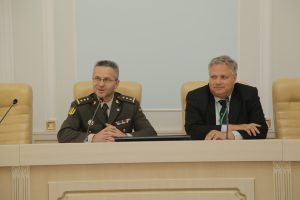
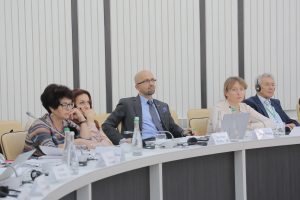
The panel discussion “Law and Security in the Context of European and Euro-Atlantic Integration” was held on September, 28 as part of the 2nd Kharkiv International Legal Forum. The round table in the conference hall of Yaroslav Mudryi National Law University gathered more than 150 participants, including representatives of international organizations (EU, Organization for Economic Cooperation and Development, UNHCR), Ukrainian and foreign scholars from Great Britain, Germany, Poland, Switzerland, experts of EU projects “Support to the Implementation of the EU-Ukraine Association Agreement” (Association4U) and “Support to Agricultural and Food Policy Implementation in Ukraine”, the Geneva Centre for the Democratic Control of Armed Forces (DCAF), the Government Office for Coordination of European and Euro-Atlantic Integration of the Cabinet of Ministers of Ukraine, the Ministry of Defense of Ukraine and Ukrainian students. The event was organized with the support of Konrad Adenauer Foundation (Kharkiv office).
The discussion covered the most pressing issues of international and national security, the latest European security initiatives, NATO’s place in the modern international security system, Euro-Atlantic strategies of Ukraine, building and maintenance of peace, achievements and key challenges of the legal dimension of European integration related to trade and sustainable development, specifics of the Deep and Comprehensive Free Trade Area between Ukraine and EU, the implementation of the Association Agreement, the influence of the Brexit process on the future of the European Union.
The panel discussion has shown the complexity and versatility of the issues of European and Euro-Atlantic integration and the place of Ukraine on the political map of Europe and in the North Atlantic area. The panel discussion took place in the form of an open dialogue of experienced politicians, government officials, employees of international and public organizations, legal business representatives, scientific community of Ukraine and foreign countries around key challenges of the legal and political dimension of the outlined topics. It contributed to the establishment of strong ties for further fruitful cooperation between representatives of the international and domestic legal community.
At the opening the participants of the panel discussion were welcomed by Yurii Barabash, Vice-Rector of Yaroslav Mudryi National Law University and Tetiana Anakina, Panel Discussion Coordinator, Associate Professor of the Department of International Law of Yaroslav Mudryi National Law University, who expressed gratitude for the sincere interest of the guests in the 2nd Kharkiv International Legal Forum, wished a fruitful discussion and expressed their hopes for the practical realization of the presented and developed proposals and ideas.
The participants were also greeted by Olga Stefanishyna (General Director of the Governmental Office for Coordination of European and Euro-Atlantic Integration), Fabio Della Piazza (Head of Political Section of EU Delegation to Ukraine), Cesar Herma (Key Expert of the EU project “Association4U”), Valeriy Koval (Head of the Judicial Department of the Ministry of Defence of Ukraine), Philipp Fluri (Assistant Director of Geneva Centre for the Democratic Control of Armed Forces), Sergii Melnyk (Head of the Military Law Faculty of Yaroslav Mudryi National Law University), Vasyl Mykhailyshyn (Project Coordinator and Researcher at Konrad Adenauer Foundation, Kharkiv).
Olga Stefanishyna, General Director of the Governmental Office for Coordination of European and Euro-Atlantic Integration of the Cabinet of Ministers of Ukraine made an opening speech devoted to the current state of Ukraine’s cooperation with the EU and NATO. “We have created all the necessary institutions to ensure the effective implementation of the EU-Ukraine Association Agreement, as well as the implementation of EU law into national legislation. Now the challenge is to ensure that these institutions take over not only the EU law, but also the EU culture of governing, which is primarily oriented towards the citizen and is known for its transparency.” She stressed that today Ukraine needs a qualified and qualitative interpretation of European law through judicial practice. According to her estimates, during the last four years Ukraine made a lot of unilateral steps towards the European integration and Euro-Atlantic direction. Ms. Stefanishyna stressed that “The Association Agreement is a bilateral document that imposes respective obligations on both sides, so today, we are working with our European partners to provide the appropriate platform for bilateral cooperation.”
The first session “NATO, EU and European Security Space” moderated by Tetiana Anakina, began with an address by Oleksiy Genchev, Head of the Expert Group on NATO Cooperation of Government Office for Coordination of European and Euro-Atlantic Integration of the Cabinet of Ministers of Ukraine. The head of the expert group stated that the main task in the field of Euro-Atlantic integration is to provide institutional capacity for effective bilateral dialogue with the North Atlantic Alliance and better understanding of this process by Ukrainian citizens. For example, Euro-Atlantic integration may result in a much more ambitious and clear institutional platform next year. “We have prepared a new format and modality of the Annual National Program under the auspices of the Ukraine-NATO Commission, which, in its goals and scale, is not inferior to the plans for action for membership in the Alliance,” said Oleksiy Genchev. The head of the expert group also noted that “the approach to NATO standards is not only about defense and security issues, but also compliance with the standards of mutual respect, new attitude towards people and gender equality.
Erwin Seyfried – Ph.D., Professor, Berlin School of Economics and Law (Germany) presented the report “Challenges for Future Cooperation of NATO and EU: Major Issues in Aligning Intelligence for Cyber Security”. Particular attention was paid to the 2016 EU’s Global Strategy in the context of the EU’s Common Security and Defense Policy; the 2017 PESCO In-depth Co-operation Mechanism, which involves 23 of the 28 EU Member States; functioning of the European Defense Fund; the results of the 2018 Brussels EU-NATO Summit; France’s security initiatives on the path to creation of the Common European Army and enhanced cooperation with NATO. The key point of the speaker is the need to strengthen cooperation with NATO against the background of existing threats, including cyberspace threats, as well as trilateral cooperation with the United States.
Chairman of the Expert Council of the Center for Army, Conversion and Disarmament Studies, DCAF/CACDS Senior expert, former Deputy Minister of Defense of Ukraine Leonid Polyakov spoke on the current state and prospects of democratic civilian control over the security sector of Ukraine. The expert analyzed the conceptual documents in the field of national security, first of all, the innovations of the Law of Ukraine “On National Security of Ukraine” of 2018. He noted a number of current tasks that still have to be solved in the context of building Ukraine as a democratic state where an effective system of democratic civilian control should be introduced. Among them there is a shortage of specialists who are fluent in foreign languages and can communicate with foreign experts, maintain dialogue and share experiences. He also drew attention to defensive planning that needs to be substantially improved.
Vartan Muradyan, UNHCR representative in Kharkiv, told about the current situation regarding the European migration crisis, which began in 2015, and the challenges faced by EU Member States. Attention was also drawn to the current situation in Ukraine. The key point of the expert: The migration crisis does not pose a threat to European identity. The migration crisis has tested the strength of the EU and the commitment of the Member States to the values on which it is based, primarily, the protection of human rights. The measures that have been implemented by the Member States of the EU prove European solidarity. The presentation was accompanied by video materials and up-to-date statistical information.


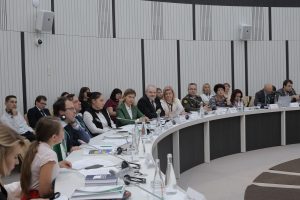


The second session under the moderation of Tetyana Anakina was devoted to the political and legal aspects of European and Euro-Atlantic integration.
Fabio Della Piazza, Head of Political Section of EU Delegation to Ukraine, gave a critical assessment of the progress of Ukraine’s European integration and fulfillment of the obligations under the 2014 Association Agreement. The main challenges and obstacles on the path to EU membership were stated and the EU position on Ukraine was expressed. The diplomat has stressed that the implementation of the commitments under the Association Agreement, which Ukraine assumed, is a difficult task, but its successful implementation can provide our country with very attractive prospects. The EU supports the European integration processes taking place in Ukraine. He stressed that the EU’s position on developments in Ukraine is unchanged and unambiguous. The EU will apply sanctions in response to violations of the principles of territorial integrity and non-use of force or threat of force.
Oesten Baller, Doctor of Law, Director of the Institute for Cooperation with Central and Eastern European Countries in Public Reform, Berlin School of Economics and Law (Germany) presented a report on European standards of legislation and quality of Ukrainian security laws. The professor drew attention to the fact that police and intelligence agencies often interfere with the constitutional rights of citizens. In order for these interventions to be justified, the relevant laws must meet certain requirements, in particular the principle of legality, proportionality, legal certainty, predictability, etc. The legal position of the European Court of Human Rights, which focuses on legislative quality, has been stated. A New Ukrainian National Security Strategy and the Law “On National Security”, Laws on the National Police, the National Guard, the Operational Investigative Activities, the Security Service of Ukraine, etc. were taken for analysis. The scientist stressed that “if the laws are of poor quality, the rule of law is in danger and it threatens fundamental rights.”
Andriy Kukharuk, External Consultant of Anti‐Corruption Network for Eastern Europe and Central Asia of the Organization for Economic Cooperation and Development (OECD), spoke about improving of the anti‐corruption system of Ukraine within the framework of European and Euro‐Atlantic integration. In particular, key anti-corruption mechanisms and initiatives were presented. Particular attention was paid to the recommendations adopted by the OECD for Ukraine and the status of their current implementation. The specifics of the political and legal relationship that exists between the implementation of these recommendations and the processes of European and Euro-Atlantic integration of Ukraine was outlined.
The third session was held in two sections. Section 1 “EU-Ukraine Association Agreement: Challenges, Achievements, Prospects for Deeper Relations” was moderated by Doctoral Researcher of the Department of International Law Tetyana Komarova.
Doctor of Law, Professor, Judge of the Constitutional Court of Ukraine, Representative of Ukraine in the Consultative Council of European Judges of Council of Europe Victor Gorodovenko reported on “Perspectives of Development of Judicial System of Ukraine in the Context of European Integration: Constitutional and Legal Aspect”. The emphasis was placed on the peculiarities of the Association Agreement’s influence on Ukrainian legal practice.
Polina Kazakevych, Head of the Expert Group on EU-Ukraine Cooperation with the Governmental Office for Coordination of European and Euro‐Atlantic Integration of the Cabinet of Ministers of Ukraine, spoke on ” Institutional Capacities in Ensuring Implementation of the Association Agreement between Ukraine and the EU”. Ms Kazakevych outlined the organizational problems that are currently of current importance in connection with the practical implementation of the provisions of the Association Agreement. Among them is the need to raise awareness of the peculiarities of the Association Agreement and the relevant EU acquis of Ukrainian lawyers, in particular representatives of the judiciary community.
Caesar Herma, a key expert of the EU project “Association4U” (Poland), spoke about the subtleties of ensuring EU law compliance throughout the law‐making process: experience of Poland and Ukraine. The expert emphasized that an effective system of checking draft legislation on the subject of compliance with EU legislation is crucial for the country’s membership in the European Union. The proposals on improving the regulatory acts of Ukraine concerning the law-making activity of the Verkhovna Rada of Ukraine and the Cabinet of Ministers of Ukraine were presented. The necessity of active involvement of legal experts – specialists in EU law in the development and adoption of regulatory acts, the subject of which is covered by the provisions of the Association Agreement with the EU, was emphasized. The positive experience of Poland was described, which allowed it to become a member state of the EU in 2004, which may be useful for Ukraine.
Roman Petrov, Doctor of Law, Professor, Head of the International and European Law Department of the National University of “Kyiv‐Mohyla Academy”, Expert of the EU project “Association4U” presented the report “Short‐term and Long‐term Challenges of Implementation of Association Agreement in Ukrainian Legal System”.
Section 2 “International, Regional and National Security Architecture” of the third session was held under moderation of Philipp Fluri, Assistant Director of Geneva Centre for the Democratic Control of Armed Forces (DCAF).
Vadym Triukhan, Head of Executive Board of NGO “European Movement Ukraine”, Managing partner of Law firm “YUMAS”, Ex-director of the Coordination Bureau for European and Euro-Atlantic Integration of the Cabinet of Ministers of Ukraine spoke on “National Security of Ukraine in the Context of the Crisis Caused by Russia’s Aggression”.
Mykhailo Samus, Deputy Director of the Center for Army, Conversion and Disarmament Studies, DCAF / CACDS Senior Expert, presented a paper “Hybrid Controversies in the European Security Space: Russian Factor.”
Vitaliy Hutnyk, Associate Professor of the International Law Department, Ivan Franko Lviv National University, spoke on the urgent issues of Ukraine’s cooperation with the International Criminal Court. Mr Hutnyk outlined the specifics of legal relations between the ICC and our state, which has twice used the opportunity to implement ad hoc jurisdiction of the ICC, provided for in Chapter 3, Art. 12 of the Rome Statute. The scientist stressed that by recognizing the jurisdiction of the ICC ad hoc, Ukraine thereby assumed the same obligations as the State party. In his view, the ratification and implementation of the provisions of the Rome Statute of 1998 is an urgent task for the near future, including in the context of fulfilling obligations under Art. 8 Association Agreements with the EU.
Vasyl Mykhailyshyn, Project Coordinator and Researcher at Konrad Adenauer Foundation Ukraine (Kharkiv) presented the report “Peacekeeping Mission in Donbas: Is There a Potential for a Peaceful Conflict Resolution?” The speech was devoted to the potential presence of the UN peacekeeping mission in Donbas to resolve the conflict. Mr Mykhailyshyn analyzed two plans for the mission’s format: Russian plan, announced by Russian President Vladimir Putin, and Ukrainian plan, promulgated by President of Ukraine Petro Poroshenko in September 2017. The Russian plan foresees placement of peacekeepers on the demarcation line for the protection of OSCE observers. The Ukrainian plan is aimed at the activities of the UN mission throughout the territory of the occupied Donbas to prevent further combat operations. In view of the dynamics of negotiations on this issue and significant fundamental contradictions between the two plans and positions of the parties, in the opinion of the speaker, the introduction of the UN peacekeeping mission to Donbas is impossible in the current political situation.
The fourth session also took place in two sections. Section 1 ” Rights of Individuals and Legal Entities in the Context of the Association Agreement between Ukraine and the EU” was moderated by a Doctoral Researcher of the Department of International Law Tetyana Komarova.
Ksenia Smirnova, Doctor of Law, Professor of the Department of Comparative and European Law of the Institute of International Relations of Taras Shevchenko Kyiv National University, Fellow of the EU project “Association4U”, delivered a report on “Europeanization of Competition Law: Steps & Challenges due to the EU‐Ukraine Association Agreement”. Ms Smirnova drew attention to the main difficulties in fulfilling Ukraine’s obligations under the Association Agreement in the area of competition. The speaker noted that in Ukrainian law practice there are gaps in a social-oriented system of competition. Legislation on competition should be considered an important legal instrument to ensure better protection of consumers’ rights. Olena Kyievets, Doctor of Law, Professor of the International Law Department of the Kyiv National Economic University, and Yulia Movchan, Ph.D., lawyer of the Ukrainian Agrarian Association, experts of the EU project “Support to Agricultural and Food Policy Implementation” spoke on “Ensuring the Food Safety in the Context of the Obligations under the Association Agreement”. The experts outlined the scope of issues in the context of achieving an adequate level of food safety in line with the international obligations of our state and proposed the best ways to ensure better implementation of the provisions of the Association Agreement between Ukraine and the EU in this area. Tetyana Komarova, Ph.D. in Law, Doctoral Researcher of the International Law Department of Yaroslav Mudry National Law University, delivered a report on “Protection of the Rights of Ukrainian Citizens and Legal Entities in the Context of the Association Agreement”. The scientist drew attention to the issue of direct action of the Association Agreement between Ukraine and the EU and presented the approach of the EU Court of Justice on similar agreements concluded by the European Union with third countries. The “highlight” of the event was the presentation of its author’s monograph “Court of the European Union: The Development of the Judicial System and the Practice of Interpreting EU Law” (Kharkiv, 2018). Section 2 ” Ukrainian Security Initiatives – Perspectives and Challenges” of the fourth session was moderated by Philipp Fluri, Assistant Director of Geneva Centre for the Democratic Control of Armed Forces (DCAF).
Oleh Tsitsak, Military Prosecutor of United Forces, and Sergiy Melnyk, Head of the Military Law Faculty of Yaroslav Mudryi National Law University, PhD, Colonel of Justice spoke on “Military Justice as the Essential Part of Ensuring National Security of Ukraine”. The experts emphasized the need for the establishment of a special law enforcement body that could now effectively counteract crime in the military sphere and carry out the functions of operational search activities and pre-trial investigation. They stressed that the full functioning of military justice, raising the level of military discipline and improving the law and order in the Armed Forces of Ukraine and other military formations is an urgent task in the context of ensuring the independence and territorial integrity of Ukraine against the background of existing challenges and threats.
Viacheslav Tseluiko, Expert on non‐governmental armed formations of the Center for Army, Conversion and Disarmament Studies, DCAF/CACDS Senior expert, V.N. Karazin Kharkiv National University, spoke on “Challenges of the Territorial Defense and Viable Reserve Formations Creation in Ukraine in Time of Hybrid War”. Mr Tseluyko noted that the system of the military reserve and the formations of the Territorial Defense in Ukraine is now undergoing a difficult path of formation and development. “This path is not devoid of false steps, suboptimal decisions and, most importantly, slow processes, which is unacceptable for the country that faces aggression from the powerful enemy, but the general vector is right. In a few years’ time, with stable and qualitative development, Ukraine can receive 25 brigades in addition to the regular and reserve brigades of the Armed Forces of Ukraine which are able to improve the protection of the rear and the territory of Ukraine from armed actions of hybrid war formations, and in case of emergency to support the Armed Forces against the regular Russian army” .
Inna Zavorotko, Officer of the Directorate General for International Law, Department of Legal Assistance of the General Staff of the Armed Forces of Ukraine “Gender Issues in the Armed Forces of Ukraine: Ukraine’s Commitments on the Way of European and Euro-Atlantic Integration”. The officer outlined the current issues of gender equality in Ukraine’s military structures. Ms Zavorotko stressed that the issue of achieving gender equality remains one of the most acute, despite some positive changes in domestic legislation. The officer spoke about NATO’s current approaches in the context of ensuring women’s rights in military structures, and noted that the EU and NATO fully support legislative reforms aimed at ensuring gender equality in the Armed Forces of Ukraine.
Tamara Bondar, Chief Expert of the Military Legislation Directorate of the Legal Department of the Ministry of Defense of Ukraine, presented a report on the peculiarities of legislative assistance for the Operations of the Joint Forces. Ms Bondar identified the main reasons for the transition to the format of the Joint Forces Operation and revealed its peculiarities. The key thesis of the report: “The introduction of Operation of the Joint Forces as a new format of Ukraine’s struggle with armed aggression of the Russian Federation in Donbas is a confident step on the path of a confident victory.”
Upon completion of the discussion panel, the moderators summarized the results. In particular, it was noted that the chosen course for European and Euro-Atlantic integration is a complicated political and legal development of the state and requires coordinated efforts of representatives of governmental and expert institutions, the involvement of the academic community, as well as assistance and support from international partners. The implementation of the proposals and ideas presented in the format of such open discussion panels can help Ukraine to bring its European and Euro-Atlantic future closer.