

Corporate Law and Intellectual Property in Digital Economy (25-26.09.2018)
On the first day of the panel the salutatory speech was made by Doctor of Law, Professor Oleksandr Petryshyn. He believes that corporate law issues are of vital importance, as the era of digital economy puts forward new requirements for law enforcement practice.


The speakers:
Inna Spasibo-Fateieva, Professor of Civil Law Department №1 Yaroslav Mudryi National Law University.
Theme: ” Legal Regulation of Corporate Relations in Ukraine: General Review “
Summary.
Prof. I. Spasibo-Fateieva: Today the urgent issues concerning legal regulations of corporate relations are as follows: different interpretations of such relations in material and procedural law; determining the subjects and the object of these relations, the issue of the time of acquiring corporate rights in individual cases. All these issues have been reflected in the court practice, displaying its ambiguous approaches to solving them. In order to overcome the existing challenges in law enforcement practice, the speaker proposed some possible solutions at the legislative level.
Valentyna Danishevska, the Head of the Supreme Court of Ukraine
Topic: “Methods of Corporate Rights Protection as an Element of Improving Access to Justice”
Summary. V. Danishevska gave some examples of the latest practice of the Supreme Court to illustrate the main problems of corporate rights protection and ways of solving them. In particular, the speaker stressed that Ukrainian legislation did not always provide effective mechanisms to protect these rights.
However, the Supreme Court does not only base its decisions on the literal interpretation of the law and tries to avoid a formal approach while resolving corporate disputes in its practice. In this context, the speaker analyzed some decisions of the Supreme Court to demonstrate its desire to protect effectively violated corporate rights. In particular, those decisions concerned the cases in which the court applied the analogy of law and the analogy of the right to protect the rights of a minority participant in a business partnership, though the latter’s voting would not particularly effect voting results, etc. The Head of the Supreme Court emphasized that the Supreme Court would continue to adhere to this approach in its practice.
Roman Sabodash, Associate Professor of the Department of Civil Law, Taras Shevchenko Kyiv National University, lawyer
Topic: “Virtual General Meeting of LLC Participants: the Problem of Participants’ Identification “.
Summary: Directive of the European Parliament and of the Council 2007/36 / EC has provided for the possibility of using a variety of electronic means of communication for calling and holding general meetings. However, electronic media used for this purpose should provide a certain level of reliability to identify participants at general meetings. Obviously, in order to implement the provisions of this Directive, the Law of Ukraine “On Limited Liability Companies”, which came into force in June 2018, provided for the opportunity to call and hold general meetings using advanced electronic communication means, such as different messengers, mobile applications, emails, etc. However, reliability of these means of communication in terms of participants’ authenticity identification at a general meeting causes doubts. In legal practice, the use of modern communication technologies can lead to massive abuses and violations and, as a result, to litigation. The speaker suggested practical recommendations on how to determine the procedure of calling and holding general meetings in the charters of LLC and SLC and analysed the means of proof in case of a dispute.
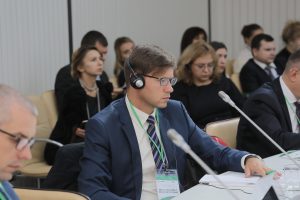


Soren Friss Hansen, Professor of Law at Copenhagen School of Business.
Topic: “Cross-Border Transformation of Companies”
Summary. The member states of the European Union consider the issue of company’s location differently: some countries define it as the place of legal entity registration, others attribute it to the so-called “real location” of a company, that is, the company’s managerial staff location. In addition, the procedure for company incorporation differs in the EU states: in some countries, the legislation imposes minimum requirements for registration of legal entities; in other countries this procedure is somewhat complicated.
The practice of the European Court of Justice shows that companies can be registered in one EU Member State, but it may operate freely in another state, and this fact is not considered a legal abuse. The adoption of common European regulations is seen as the further step that would allow the owner to transfer a place of registration of a business or its headquarters from one EU Member State to another and avoid its liquidation in the country where it is registered. For this purpose the EU has developed a set of amendments to the Directive of the European Parliament and of the Council 2017/1132 / EC, which is supposed to supplement the section on cross-border mergers and divisions of legal entities.
Piotr Pignor, Head of the Department of Commercial Law at the Silesian University of Katowice, Wojciech Vyzykowski, Associate Professor of the Department of Commercial Law at the Silesian University of Katowice
Topic: “Transparency Policy in Corporate Law in Accordance with Directive 2017/828”
Summary. Directive of the European Parliament and of the Council 2017/828 / EU aims to amend and update Directive 2007/36 / EC in order to increase activity transparency of companies listed on stock exchanges and publicly place their shares. In particular, in today’s practice of public companies in the EU countries there are some urgent issues: the problem of shareholders’ identification, they often operate through their numerous representatives; the lack of shareholders’ awareness concerning remuneration received by company CEOs: the problem of nondisclosure of information on transactions with related parties concluded by CEOs of public companies to their shareholders and third parties (in particular, the creditors of these companies). Directive 2017/828 / EC introduces mechanisms of dealing with these problems, obliging Member States to introduce relevant legal regulations so as to increase the transparency of public companies’ activities.
The speaker gave his opinion on the provisions of the Directive in terms of their effectiveness and the possibility of their effective implementation in the national legislation of the Member States.
Charles K. Whitehead, Professor of Cornell University
Topic: “Private investments, the ways to increase the capital of the companies and their security”
Summary. In his speech professor Whitehead has declared that nowadays in Ukraine, on the one hand, there is an inconsistency between the level of technological development and start-ups development, and, on the other hand, between the economic development and the legal support of investment activity. Despite the Ukrainian companies attracting foreign investors with the innovative development, corruption and the other risks within the state have significantly restrained attraction of foreign investments. In order to overcome this problem, professor Whitehead has proposed a scheme of organizing the investments attraction in the Ukrainian economy. This scheme provides for setting up of a company beyond Ukraine (for instance, in some European country with the inviting investment climate), which will have rights to assets and innovative development of business entity, made and operated according to the Ukrainian legislation. This foreign company should undergo a process of listing in the European stock markets and propose to sell its stocks of different risk level and in accordance with various incomes (dividends). In this way Ukrainian business entity will be able to obtain investments abroad, while foreign investors could have guaranteed opportunity of getting profits from stocks’ ownership.
Professor Whitehead has underlined that the fulfillment of such scheme investments attraction should be supported by laws: the Ukrainian legislation must provide for explicit and transparent guarantees, mechanisms to support the existence of such scheme.
The following day began with the greeting of I. Spasibo-Fateieva and representative of a law firm “Esquires”. He emphasized the importance of corporate law discussion as the most current issue in the practice of law enforcement.


Virginijus Bité, Professor and Director of the Institute of Private Law at Faculty of Law, Mykolas Romeris University.
Topic: “Conflict of interest between majority and minority stockholders in close-end companies: the Lithuanian experience”
Summary. In his speech professor Bité has drawn attention to the most crucial issues in the activity of the Lithuanian close-end companies, such as, lack of imperative regulation of legal transactions with concern, determining the duties of the close-end companies stockholders, bringing to justice those stockholders who abuse their rights, bringing indirect suit etc. Each of the problems have not been clearly resolved both in the Lithuanian legislation and in law enforcement practice of the Lithuanian Supreme Court. Consequently, professor Bité has proposed the ways of dealing with the current issues with the prospect of their application in Ukraine for resolving similar disputes.
Maksym Libanov, member of National Securities and Stock Market Commission of Ukraine.
Topic: “Last amendments to corporate administration in joint-stock companies: achievements and expectations”
Summary. M.O. Libanov has widely analyzed the amendments to the Law of Ukraine “On the joint-stock companies” which were made during 2017. The speaker has underlined that these amendments have significantly reinforced the role of the supervisory board, providing it with the exclusive competence, detailed the process of joint-stock companies absorption. In general, these amendments were guided by the necessity of the EU directive provisions implementation in the Ukrainian legislation, regulating various issues of company activity. The member of NSSMCU has positively evaluated the amendments and analyzed prospects of the legislative development of join-stock companies in the nearest future.
Volodymyr Igonin, partner of law firm “Vasil Kisil & Partners”, lawyer.
Topic: “Corporate administration in Ukraine: practical challenges and trends”
Summary. In his speech V. Igonin has outlined the main issues of the corporate administration in Ukraine. His speech was supported by the statistical study which was carried out on the basis of survey of more than a hundred respondents. Among polled questions there were the issues concerned with stockholders trust in supervisory board, formation of its preferable lineup, gender policy development in the executive bodies and the control authorities over joint-stock company. The study’s results have confirmed that, in general, legal regulation of corporate administration needs to be improved.
Valeriia Diachenko, lawyer of law company “Juscutum”.
Topic: “Cybersecurity and information security as the main components of company safety”.
Summary. In her speech V. Diachenko has analyzed the main issues, appearing in the practice providing information security at the level of particular companies. The speaker has emphasized the necessity to build locally reliable policy of information security, adequate for the contemporary reality. The development of company and key indicators of its activity will depend on this policy.

